Cardiovascular Health Toolkit

A smiling man standing outside at a park holding a basketball with a clear bottle of Florida Orange Juice

Share :

Print

Overall dietary patterns matter in heart health, and making nutrient-dense choices can play a meaningful role. 100% orange juice offers a combination of nutrients — including vitamin C, potassium, folate and hesperidin — that supports blood vessel function, healthy blood pressure and other aspects of heart health. 

This toolkit provides science-backed information and practical resources to help you translate the evidence into patient guidance and everyday recommendations.

What’s included on this page:

Benefits at a Glance |  Resources  |  Recipes  |  Supporting Research

Benefits at a Glance

Use this at-a-glance summary to quickly reference the key nutrients in 100% orange juice and their connection to heart health. The ready-to-use talking points can support your work with patients and other cardiovascular health communications. 

  • An 8-ounce serving of 100% orange juice is a/an: 
    • Excellent source of vitamin C, which helps support healthy blood vessels by improving blood flow.1 
    • Good source of potassium, which helps maintain fluid balance and supports normal blood pressure. Diets containing foods that are a good source of potassium and low in sodium may reduce the risk of high blood pressure and stroke.2 
    • Good source of folate and thiamin, which also support cardiovascular health. Folate helps break down homocysteine, an amino acid linked with heart health, while thiamin plays a role in energy metabolism needed for normal heart function.3,4 
  • 100% orange juice has no added sugar, is fat-free and cholesterol-free, and offers vitamins, minerals and bioactive compounds that support heart health. 
  • 100% orange juice offers hesperidin, a naturally occurring phytonutrient found in citrus, and emerging research suggests it may support healthy blood pressure and blood vessel function.5 

Resources

For additional support, explore resources ranging from patient-friendly handouts to deeper research insights, all designed to support health professionals across practice settings.
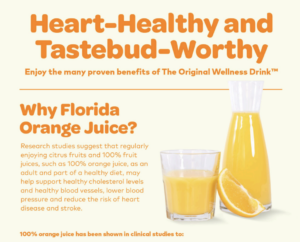
A patient-friendly infographic that summarizes the heart-supportive nutrients in 100% orange juice and how they contribute to cardiovascular wellness.
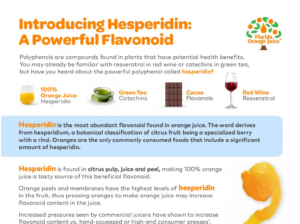
A printer-ready handout providing an overview of hesperidin (a flavonoid most abundantly found in citrus) and its potential benefits for supporting heart health.

A comprehensive webpage featuring detailed insights and research on 100% orange juice and its heart-healthy qualities and benefits to support your guidance.

Recipes

You may have visited our Recipe Hub. We’ve selected a few options below that bring together heart-supportive ingredients and showcase the versatility of 100% orange juice across a variety of dishes.

Orange Oat Banana Waffles

Whole grain waffles made with Florida Orange Juice bring heart-smart nutrition and a subtle sweetness to the breakfast table. Enjoy with your favorite fruits!

Smoky Citrus Mushroom Tacos

The mushrooms in these plant-forward tacos are basted with Florida OJ and spices, then roasted for smoky citrus flavor in a satisfying handheld.

Golden Citrus Baba Ghanoush

Blending sauteed eggplant with Florida Orange Juice and aromatic spices creates crave-worthy dip to pair with veggiescrackers or warm pita.

Supporting Research

A growing body of evidence suggests that 100% orange juice may play a role in supporting cardiovascular health through its unique combination of nutrients and beneficial plant compounds. Research has linked its intake to improvements in blood pressure, vascular function and inflammation. Much of this research has focused on hesperidin, along with vitamin C, potassium and folate. Continued research is helping to further understand the role of 100% orange juice in long-term heart health.

References

 
  1. Vitamin C: fact sheet for health professionals. National Institutes of Health, Office of Dietary Supplements. Updated July 31, 2025. Accessed January 23, 2026.https://ods.od.nih.gov/factsheets/VitaminC-HealthProfessional/ 
  2. Potassium: fact sheet for health professionals. National Institutes of Health, Office of Dietary Supplements. Updated June 2, 2022. Accessed January 23, 2026. https://ods.od.nih.gov/factsheets/Potassium-HealthProfessional/  
  3. Folate: fact sheet for health professionals. National Institutes of Health, Office of Dietary Supplements. Updated November 30, 2022. Accessed January 23, 2026. https://ods.od.nih.gov/factsheets/Folate-HealthProfessional/
  4. 4.Thiamin: fact sheet for health professionals. National Institutes of Health, Office of Dietary Supplements. Updated February 9, 2023. AccessedFebruary 3, 2026.  https://ods.od.nih.gov/factsheets/Thiamin-HealthProfessional/  
  5. Valls, Rosa M et al.“Effects of hesperidin in orange juice on blood and pulse pressures in mildly hypertensive individuals: a randomized controlled trial (Citrus study).” European journal of nutrition vol. 60,3 (2021): 1277-1288. doi:10.1007/s00394-020-02279-0 
  6. Aune,Dagfinn et al. “Fruit and vegetable intake and the risk of cardiovascular disease, total cancer and all-cause mortality-a systematic review and dose-response meta-analysis of prospective studies.” International journal of epidemiology vol. 46,3 (2017): 1029-1056. doi:10.1093/ije/dyw319 
  7. Fraga, Layanne Nascimento, et al. “A Global Transcriptomic Analysis Reveals Body WeightSpecific Molecular Responses to Chronic Orange Juice Consumption in Healthy Individuals.” Molecular Nutrition & Food Research, 30 Oct. 2025, pp. e70299–e70299,https://doi.org/10.1002/mnfr.70299 

Share :

Print